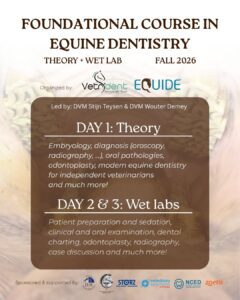
Foundational Course in Equine Dentistry
Theoretical Day: 22nd of October 2026
Optional: Practical Days: 23rd – 24th of October 2026 or 19th –20th of November 2026
A three-day, independent, evidence-based course designed to provide all kind of equine veterinarians and veterinary students with a solid scientific foundation in equine dentistry, followed by intensive supervised practical training. The course is divided into one theoretical day and two practical wet-lab days.
Participants may attend the Theory Day as a standalone course, or choose to follow it with two practical days either on the 23rd–24th of October 2026, either on the 19th –20th of November 2026, depending on availability.
Led by Wouter Demey (Equide) and Stijn Teysen (Vetrident), in the spirit of the Nordic College of Equine Dentistry (NCED) and proudly supported by the Independent Belgian Equine Veterinarians (IBEV).
Course Structure
Thursday 22nd of October 2026
Day 1 – Theoretical Foundation on Equine Dentistry in a conference room in Brussels · Open to all veterinarians and veterinary students· No participant limit
The first day provides the scientific framework on which modern equine dentistry is built. Rather than focusing on techniques alone, the lectures explain the biological principles behind normal anatomy, pathology, diagnosis, and treatment, enabling participants to approach equine dentistry with a critical, evidence-based mindset.
Topics include:
-
-
- Evolution, applied embryology and anatomy – understanding the biology of hypsodont teeth
- Equine dentistry within the context of modern veterinary medicine
- Performing a systematic oral examination, including open- and closed-mouth oroscopy
- Recognition and interpretation of oral pathology
- Odontoplasty (“floating”) critically evaluated: evidence versus tradition, supported by clinical examples
- Dental radiography: indications, standard projections, and practical image acquisition
- Advanced techniques (diagnostic and therapeutic) – an overview
- The role of the independent equine veterinarian, and what’s next for IBEV (Independent Belgium Equine Vets)
-
Day 1 may be attended independently and is suitable for every veterinarian/veterinary student seeking a stronger theoretical understanding of equine dentistry.
Days 2 & 3 – Practical Wet Laboratories
Stable setting · Minimum 6 – Maximum 8 delegates · Two participants per horse
Delegates who wish to complete the full programme choose one of the following practical tracks:
-
-
- Track A: Friday 23rd & Saturday 24th of October 2026
- Track B: Thursday 19th & Friday 20th of November 2026
-
The practical component translates the principles learned on Day 1 into clinical practice. Working in pairs under continuous supervision by experienced tutors, participants perform the complete clinical workflow on live horses in a structured, evidence-based manner. Each practical cycle includes:
-
-
- Safe patient preparation and sedation
- Clinical head examination
- Comprehensive oral examination
- Dental charting
- Guided evidence-based odontoplasty
- Dental radiography
- Case discussion and treatment planning
-
Over the two practical days, every participant completes this entire workflow twice, each time on a different horse. This deliberate repetition allows delegates to consolidate their examination technique, improve clinical reasoning, and build confidence in performing routine equine dental procedures.
Day 2
The day begins with a concise practical introduction covering dental instruments, safety, ergonomics, and sedation. Before participants work on their own horses, both tutors perform a full live demonstration on a dedicated demo horse, walking through the complete workflow — sedation, instrument handling, oral examination, and dental charting — so that delegates see the entire process at teaching pace before doing it themselves.
Each pair then performs a complete oral examination on their assigned horse, records a dental chart, and carries out guided odontoplasty under tutor supervision. The day concludes with case presentations in which each pair discusses their clinical findings and proposed treatment plan.
The first practical day is followed by a course dinner.
Day 3
The final day begins with a practical briefing on dental radiography, covering standard projections and image acquisition in a clinical setting. Participants are then assigned a new horse and begin their second complete clinical cycle as tought the day before (sedation, clinical head examination, comprehensive oral examination, and dental charting).
Following the examination, delegates split into two groups. One group performs X-ray assessment, acquiring and evaluating clinically relevant projections, while the other carries out guided odontoplasty based on their findings and as tought the day before. After a case-based lecture on X-ray interpretation, the groups switch, ensuring every participant gains hands-on experience in both radiographic assessment and evidence-based odontoplasty.
The course concludes with case presentations in which each pair discusses their clinical findings, radiographic images, and treatment decisions, followed by a final summary and the presentation of course certificates.
Course Outcomes
Participants leave with a biological and evidence-based framework for equine dentistry. Delegates completing the full programme gain hands-on experience in oral examination, dental charting, dental radiography, evidence-based odontoplasty, and clinical decision-making. Course certificates are delivered upon completion.
Price
-
-
- Day 1 (theory): free of charge for all vets and students, Coffee and lunch included
- Day 2+3 (wet-lab): €1475 excl. VAT — dinner on Day 2 included (night of first day of practicals). Coffee, lunch and dinner included.
-
Registration